
Pre-Departure Guide for Teachers Moving to Thailand
Pre-Departure for Teachers: Golden Folder, Visa Path, First Weeks
Sawasdee from Ban Lum, Sukhothai. I have lived in Thailand for 20 years, and the teachers who arrive calm are the ones who packed their paperwork properly. This guide walks you through the Golden Folder you carry in the cabin, the visa path from exemption stamp to Non-B and work permit, the TDAC arrival card, your cash buffer, school clothes, and what happens in your first weeks with us.
Jump to a Module
Pick a module to go straight to it. Everything is on this one page.
"If paperwork runs slow or your flight changes, please do not panic. Our coordinator team and I are here in Ban Lum, Sukhothai, on WhatsApp and LINE, and we will sort out dates with you before you board."
Thailand Facts & Climate
The basics I wish someone had told me: plugs, time zone, bank hours, and what the weather does to a school day in the north.
Country Standards
- Time Zone: GMT+7 (Indochina Time, no daylight saving shifts).
- National Currency: Thai Baht (THB).
- Power Outlets: 220V at 50Hz (Types A, B and C). Modern laptop and phone chargers work without a step-down transformer.
- Banking Hours: Mon-Fri 08:30 to 15:30 (mall branches open until 19:00 daily).
Three Broad Seasons
- Cool Season (Nov-Feb): Morning flag assemblies can drop to 14°C-19°C in Sukhothai and Lampang. Pack a light cardigan or smart blazer.
- Hot Season (Mar-May): Afternoon highs reach 38°C-41°C. Breathable cotton shirts and sweat-wicking undershirts make a real difference.
- Rainy Season (Jun-Oct): Short, heavy afternoon downpours. Keep a compact poncho in your commuter bag; rain does not cancel school.
The Golden Folder
Your Golden Folder travels with you in the cabin: degree, transcripts, police check, passport and TEFL certificate. Originals only, never laminated, and never in a checked suitcase.
Original Passport
At least 6 months validity from your arrival date, and 2 blank facing pages for entry stamps, extension stamps and your Non-B visa.
Bachelor's Degree
Your original degree and sealed university transcripts, legalized or apostilled in your home country. Never laminated. See our degree legalization guide.
Criminal Clearance
Your national police certificate (FBI Identity History Summary, UK DBS, Australian ACIC or Irish Garda), issued within 6 months of departure.
TDAC Arrival QR
The confirmation QR code from tdac.immigration.go.th, saved as a screenshot on your phone and printed as a backup.
TEFL Certificate
Your original 120-hour TEFL or CELTA certificate. Schools value it when they bring you on board.
Passport Photos
12 printed passport photos (4 × 6 cm) in a collared shirt on a royal blue background, for school records and immigration forms.
Do Not Laminate Anything in the Folder
Never laminate your degree, transcripts or police check. Thai offices, including the Teachers' Council of Thailand (Khurusapha) and the Department of Employment, check originals by hand for raised university seals, ribbons and watermarks. Lamination hides them and can mean ordering an expensive replacement from your university.
Visa Path, Exemption Stamp & TDAC
An exemption or tourist stamp gets you into the country; it does not let you work. You need a Non-B visa and a work permit before you teach a class. Confirm the details the week you fly.
| Entry Route | How Long You Can Stay | What It Is For |
|---|---|---|
| Visa Exemption (60 Listed Countries) |
30 Days on Arrival (+30 day TM.7 extension) |
Some teachers arrive this way while the school finishes the paperwork for the Non-B visa and work permit. It is not permission to work. It can be extended once at provincial immigration with a TM.7 (fee commonly cited at 1,900 THB; confirm that week). Land entries on an exemption are limited to twice per calendar year. Check current rules at immigration.go.th. |
| Direct Non-B e-Visa (Arranged Before You Fly) |
90 Days on Arrival (work permit follows) |
Possible when your placement is confirmed 6 to 8 weeks before departure and your school prepares its Department of Employment WP-3 letter for an e-Visa application at thaievisa.go.th. More in our Non-B visa guide and work permit guide. |
Extending an Exemption with TM.7
If you entered on a 30-day exemption and your Non-B is not ready yet, we usually visit the provincial immigration office (for example Sukhothai or Phitsanulok) between Day 15 and Day 25. Bring:
- The TM.7 form with one 4 × 6 cm photo attached.
- Signed copies of your passport photo page, latest entry stamp and TM.30 slip.
- The fee in cash. It has been 1,900 THB; treat that as an example and confirm that week. Cards are not accepted at the counter.
- Immigration can then add up to 30 more days to your stay.
If the School's Document Pack Is Late
Most teachers never need this. It only matters if the school's document pack runs late and your permitted stay is getting short. Your coordinator will tell you which route fits.
In-country conversion: done at provincial immigration when the school's document pack is complete and you still have enough days left on your stamp (plan on 15 to 21 days; confirm with the office).
Laos visa run: a trip to a Thai embassy or consulate in Laos, such as Vientiane or Savannakhet, to apply for the Non-B there. Consulates check your documents in person.
Travel & Cross
Travel to the border and cross into Laos with your full school document pack.
Apply
Hand in your paperwork at the Thai embassy or consulate and pay the consular fee (confirm the amount that week).
Wait
The consulate reviews your documents. How long this takes depends on the office and the time of year.
Return on the Non-B
Collect your passport with the visa, re-enter Thailand, and the school moves on to your work permit.
Official Portals
Bookmark these official websites. The official arrival card at tdac.immigration.go.th is free:
Money, Cash Buffer & Living Costs
Every figure below is an example to help you plan, not a quote. Prices and fees move, so confirm them the week you fly.
Cash Buffer: An Example
$1,500 to $2,000 USDAs an example, bring $1,500 to $2,000 in crisp, uncreased $100 notes, and confirm the amount that week. Exchange booths in Thailand often refuse notes with tears, ink marks, pinholes or heavy creases. The buffer covers your orientation week fee (13,000 THB at the time of writing; confirm that week), a room deposit (usually one month's deposit plus one month's rent), and food until your first pay.
Thai Bank Accounts & Payday
Banks such as Kasikornbank, Bangkok Bank and SCB ask for your Non-B visa, your work permit and your TM.30 slip before they open an account. You will open yours in your first weeks at school, and your coordinator will help. Until your PromptPay QR works, schools pay your first salary in cash.
| Expense Category | Monthly Cost (THB, Example) | USD (Approx.) | Notes |
|---|---|---|---|
| Studio Apartment (Furnished, Air-Con) |
3,200 - 6,000 ฿ | $90 - $175 USD | Air-conditioned studio with private bathroom and balcony. You pay rent directly; our coordinators help you find and inspect rooms. |
| Electricity & Air Conditioning | 800 - 1,600 ฿ | $25 - $48 USD | Depends on how much you run the air-con at night. A government meter usually costs less than an apartment's own meter. |
| Water & Fiber Internet | 350 - 550 ฿ | $10 - $16 USD | Town water plus fibre Wi-Fi in your room. |
| Daily Food & Night Markets | 5,500 - 8,500 ฿ | $160 - $245 USD | Night market dinners (around 40 to 60 THB a dish) and school canteen lunches. Eating local keeps costs low. |
| Motorbike Rental & Fuel | 2,500 - 3,500 ฿ | $70 - $100 USD | 125cc automatic scooter including fuel. You need a valid home motorcycle licence plus an IDP. |
| Total Monthly Living Base | 12,350 - 20,150 ฿ | $355 - $584 USD | On a standard KET placement (30,000 to 36,000 THB net), many teachers save 10,000 to 15,000 THB a month. All figures are examples; confirm that week. |
School Clothes & Appearance
Teachers are respected in Thailand, and modest, smart clothes are the easiest way to show respect for your school and students. Our packing guide has the full list.
Men's School Clothes
- 5 to 6 crisp, ironed long-sleeve collared dress shirts (light blue, white, and pastels).
- 3 to 4 pairs of smart trousers in navy, charcoal or black (no jeans or cargos).
- 2 to 3 ties (expected at morning assembly and flag ceremonies).
- Polished black or dark brown leather dress shoes with dark socks.
- Clean-shaven or neatly trimmed facial hair. Visible tattoos must be covered during school hours.
Women's School Clothes
- 4 to 5 modest tailored skirts or dresses that cover the knees when seated.
- 5 to 6 modest short- or three-quarter-sleeve blouses (shoulders and chest covered).
- Closed-toe flats, loafers or low block heels (no sandals or flip-flops).
- A smart cardigan or lightweight blazer for air-conditioned staffrooms.
- Leggings, see-through fabrics and sleeveless tops are not worn at school.
Monday Yellow, Friday Mor Hom
Many schools wear yellow on Mondays, the royal birthday colour. On Fridays, many northern schools wear the indigo-blue mor hom shirt or a school polo. This is custom, not law, and it varies from school to school, so follow what your colleagues wear. Shirts are inexpensive at local markets (as an example, 250 to 400 THB; confirm that week), and you can pick them up during orientation week.
Health, Safety & Work Permit Medical
The work permit medical, social security, clean water, and emergency dispatch numbers.
Hospital Medical Check
The work permit needs a Thai hospital medical certificate: a physical check, blood pressure and routine screening for the conditions listed in labour rules. As an example, it has cost 200 to 600 THB; confirm that week.
Social Security (SSO 33)
Once your work permit is registered, 5% of your salary is deducted for social security healthcare, up to a monthly cap (750 THB at the time of writing; confirm that week). It gives you free treatment at your registered provincial hospital. Carry private travel insurance for your first weeks.
Drinking Water & Ice
Do not drink tap water; bottled water is inexpensive and everywhere. Tube ice (the cylinders with a hole) is made from filtered water in licensed factories and is safe.
Emergency Contacts
Save these hotlines: 1669 for Medical Emergencies and Ambulances, 1155 for Tourist Police (English-speaking 24/7), and 191 for Royal Thai Police dispatch.
Your First 30 Days: Week by Week
Every intake goes through roughly the same weeks. Knowing the shape of it takes a lot of the worry away.
Orientation Week
Mo Chit 2 pickup, hotel stay in Sukhothai, 5G SIM card, culture workshops, basic Thai, and meeting the other new teachers.
Apartment Move-In
Travel to your school town with our staff, collect your keys, check your landlord has filed your TM.30, and meet the school director.
Classroom Launch
Meet your Thai co-teacher, learn the bell schedule, set up your classroom routines, and start teaching once your paperwork allows.
Settling In
Life finds its rhythm. Your TM.7 extension goes in if you need one, your bank account opens when your paperwork allows, and town life starts to feel normal.
Phone, SIM & Apps
Install LINE, Grab, Google Maps and Google Translate before you get on the plane, while you still have home Wi-Fi. Our Thailand apps guide explains each one.
Carrier-Unlocked Phone
Check with your home carrier that your phone is carrier unlocked before you leave. A locked phone will not take a Thai SIM. You get an unlimited 5G Thai SIM card during orientation.
Bring a Laptop
Bring your own laptop and an HDMI adapter. Thai public schools do not supply laptops to teachers, and you will use it every day for lesson plans, slides and grades.
Culture, Respect & the Staffroom
Thai school life runs on courtesy and a calm manner. Get these few things right and colleagues will warmly support you.
The Thai Wai
Palms together in front of your chest with a slight bow. Students will wai you first; return it with a nod and a warm smile. With the school director and senior colleagues, you wai first.
Jai Yen & Body Taboos
Do not touch anyone's head. Do not point your feet or the soles of your shoes at people, monks or Buddha images. Keep a cool heart (Jai Yen) and never raise your voice in anger; doing so causes loss of face.
Respect for the Monarchy
Respect for the Royal Family is deep and legally protected. Stand still when the national anthem plays at the 08:00 morning assembly, and never damage banknotes or coins with royal portraits.
Sukhothai Orientation Week
Every intake starts with us in Sukhothai: training, help with paperwork, and meeting the people you will lean on all year.
What the Orientation Fee Covers
The one-time orientation fee (400 USD, paid in cash on the Sunday; at the time of writing that is 13,000 THB, but confirm that week) covers a group VIP van transfer from Mo Chit 2 terminal in Bangkok directly to Sukhothai (teachers arrange their own airport transit to the Mo Chit 2 meeting point; no direct airport pickups), 5 nights private hotel accommodation with air-conditioning (checking out Thursday morning), all training meals, 5G local SIM card, professional visa portrait photos, guided sunset excursion to the UNESCO Sukhothai Historical Park, and live micro-teaching sessions with Thai students.
✓ On Thursday morning, our staff travel with you to your placement town and school, help you check into your studio, and make sure your landlord files your TM.30.
Read the full Sukhothai Orientation Week Guide →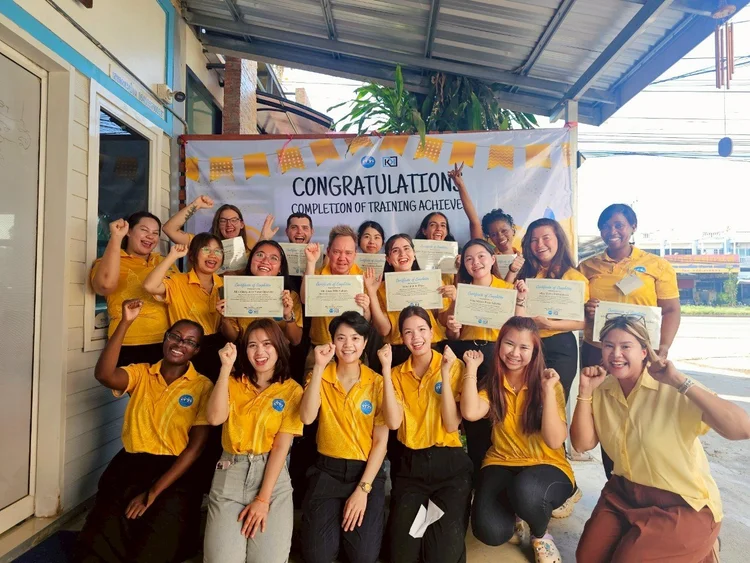
Housing & TM.30
Your landlord, not you, files the TM.30 address notice. Your job is to rent from someone who will file it, and to keep the slip.
Studio Move-In & Rent
Our coordinators check clean, safe studio apartments 5 to 15 minutes from your school. As an example, rent is typically 3,200 to 6,000 THB a month (confirm that week). Rooms come with a private bathroom, air-con, fridge, bed and wardrobe. You pay rent directly; we help you find, inspect and agree the lease.
Your TM.30 Slip
Under Section 38 of the Immigration Act, your landlord or host reports your address to Immigration, usually within 24 hours of you moving in. Ask for the TM.30 slip, paper or digital, and keep it with your passport. You will need it for a TM.7 extension and to open a bank account. More in our TM.30 guide for teachers.
At the Airport & Your Checklist
What to have ready at the immigration desk, and a checklist you can tick off as you pack.
At the Immigration Desk
Enter only on the stamp you actually hold. Do not start paid classroom work until your Non-B visa and e-Work Permit are in place. If you are coming to take a KET job, talk to your coordinator about the entry route before you buy the ticket; do not guess an answer at the desk. Have your onward flight booking, funds to show if asked (as an example, 20,000 THB; confirm that week) and your TDAC QR screenshot ready on your phone.
