Thailand Non-Immigrant B Visa Guide: The Strategic Blueprint for Teachers & Professionals

๐Ÿคซ SHHH... JUST THE GOOD STUFF

โšก NON-B VISA STRATEGY (2026 UPDATE):

  • The e-Visa Reality: 100% of Non-B applications from home are now "stickerless". Your visa is a PDF; do not wait for a physical passport return.
  • The Biometric "Golden 12": You have exactly 12 minutes at a Provincial Labor Office to provide fingerprints and a high-definition iris scan. This unlocks your credit-card-sized Digital Work Permit.
  • The TCT Hack: You no longer need to finish all 7 modules to start teaching. Complete 4 modules via OnePlatform to trigger your 2-year temporary license immediately.
  • The TDAC Change: The paper TM6 is dead. The Thailand Digital Arrival Card (TDAC) is mandatory for all entries.

Passport with Non B visa Thailand

๐Ÿ“– The Journey: From Documents to Classroom

The path to teaching in the Heartland is a coordinated dance between you and your school. Typically, the process begins 1-2 months before your flight. You submit scans of your authenticated degree, transcripts, and passport biodata page to the school or KET.

Once processed, the school issues your official invitation and WP3 pre-approval, which are emailed to you. Armed with these, you tackle local requirementsโ€”gathering bank statements and proof of residenceโ€”to submit your e-Visa.

But what if things aren't perfect? If you are already outside your home country or do not yet meet bank balance requirements, the strategy shifts. You enter Thailand as a tourist (via the 60-day exemption) and then take the Visa Run route to Laos once your paperwork is ready. Regardless of your path, you must bring all original documents (passport, degree, transcripts, background check) to Thailandโ€”scans alone will not secure your final work permit.


๐Ÿ“‹ Pre-Application: The Apostille "Double-Stamp"

In 2026, document "justice" is binary. If itโ€™s not Apostilled or authenticated, itโ€™s an automatic rejection. While Thailand officially approved accession to the Hague Apostille Convention in late 2025, traditional legalization remains the mandatory standard until the international mechanics fully take force.

The Core Essentials

  • The Teacher's Mandate: You must legalize your Original Bachelor's Degree and a Criminal Background Check (issued within the last 3-6 months).
  • Transcript Rule: While original transcripts must be brought to Thailand, they typically do not require notarization or legalization.
  • Translation Requirement: If your degree is not in English, you must obtain a certified translation that explicitly uses the word "Bachelor".

The 3-Step Legalization Workflow

For most applicants (US, UK, Canada, South Africa), the process follows this "Double-Stamp" logic:

  1. Local Notarization: A licensed notary public certifies a high-quality copy of your degree. Warning: Never legalize or write on your original degree; Thai authorities often reject altered or laminated originals.
  2. Government Authentication: Your notarized document is sent to your home country's designated authority (e.g., Secretary of State in the US or the FCDO in the UK) to verify the notary's seal.
  3. Thai Embassy Legalization: The final, most critical stamp comes from the Royal Thai Embassy or Consulate with jurisdiction over your region. This confirms the document's legitimacy for use within the Kingdom.

The WP3 Anchor

Before you can finalize your e-Visa, your school must file a WP3 application in Thailand. This generates a digital approval letter from the Department of Employmentโ€”this is the most critical file for your e-Visa upload.


Kids English Thailand teachers travelling with their passport

๐Ÿ’ป Step-by-Step e-Visa Portal Guide (v2026)

Since January 1, 2025, the official thaievisa.go.th portal has been the mandatory, 100% "stickerless" gateway for all Non-Immigrant B applications. You no longer submit your physical passport to the consulate; instead, you receive a digital e-Visa PDF via email to print for your journey.

1. Account Creation & Activation

  • Register: Visit the official Thai e-Visa website and create a user profile.
  • English Only: All details must be entered in English.
  • Activate: Click the activation link sent to your email within 30 minutes to verify your account.

2. Strategic Application Setup

  • Purpose of Visit: Select "Non-Immigrant Visa" and sub-category "B" (Teaching/Business).
  • Embassy Selection: You must select the specific Thai Embassy or Consulate-General that has jurisdiction over your current legal residence.
  • Timing: Apply approximately one month before your departure. Do not apply more than 3 months in advance, or your visa may expire before you travel.

3. The Digital Document Stack

In 2026, AI-driven screening rejects "paper-thin" or blurry scans. Ensure all uploads are crystal-clear PDFs or JPEGs under 200 KB (some portals allow up to 5MB, but 200KB is the standard portal limit).

  • Facial Image: A recent (within 6 months) passport-sized photo with a plain white background.
  • Passport: A clear scan of your biodata page (valid for at least 6 months).
  • Sponsor Documents: Upload your WP3 Approval Letter, Invitation Letter, and School License.
  • Personal Proof: Upload your legalized degree and criminal background check.

4. Fees & Processing

  • Payment: Pay the non-refundable fee online via the e-payment section (typically 2,000 THB for single entry).
  • Wait Time: Standard processing takes at least 15 working days. You can track your status via the portal dashboard.
  • Approval: Once approved, the e-Visa is sent to your registered email. Print this PDFโ€”you must present it to airlines and immigration.

5. Mandatory Entry Protocol: TDAC

Effective May 1, 2025, the digital arrival card is no longer optional.

  • Register: Complete the Thailand Digital Arrival Card (TDAC) at tdac.immigration.go.th at least 72 hours before arrival.
  • QR Code: You will receive a QR code that allows you to use the automated gates at major international airports.

Gather all of necessary documents for non b visa in Thailand

๐ŸŽ Track 01: The Teacher's Mission & 7-Modules

In 2026, the Teachers' Council of Thailand (Khurusapha) has fully digitized the educator pathway through the OnePlatform ecosystem. [cite_start]This track is the mandatory route for classroom educators, university faculty, and language mentors entering on a Non-B Visa[cite: 202].

The 7-Module Requirement (TPDI)

If you do not hold a Bachelorโ€™s degree specifically in Education, you are required to complete a 7-module professional training curriculum to obtain a full license.

  • The Modules: Each module consists of 60 hours (48 theory, 12 Zoom seminars) covering pedagogy, psychology, and classroom management.
  • The Fast-Track (P-License): You do not need to wait for full completion. Once you finish Modules 1-4, you can apply for a 2-year Provisional Teaching License (P-License) to begin your legal career immediately.
  • Registration: This is handled via the Khurusapha OnePlatform at a cost of approximately 3,200 THB per module.

The 2026 Medical Protocol

[cite_start]Within 30 days of landing in Thailand, you must visit a licensed clinic or hospital for your work permit health clearance[cite: 189, 1241].

  • Mandatory Tests: In 2026, the certificate must include a blood test for Syphilis and a chest X-ray to clear you of Tuberculosis (TB).
  • Home Country Scans: Note that medical certificates from your home country are not accepted for the Thai work permit; you must use a local Thai provider.

Biometrics: The Final Activation

After your school files the digital application, you will be scheduled for a biometric session at the Provincial Labor Office.

  • The Session: A strict 12-minute window to capture 10 fingerprints and a high-definition iris scan.
  • The Goal: This biometric data activates your Digital Work Permit, which replaces the old "Blue Book" and appears as a secure QR code in your ThaID app.

๐Ÿ“‘ 2026 Sponsor Document Checklist (School-Side)

In 2026, over 80% of portal rejections are caused by incomplete or incorrect school-side filings. To protect your mission, you must ensure your KET caseworker or school administrator provides these exact high-resolution digital files for your e-Visa upload.

The Essential "Sponsor Stack"

  • Official Invitation Letter: Must be printed on school letterhead, signed by the Director, and addressed specifically to your local Embassy/Consulate.
  • WP3 Approval Letter: This is the digital "Letter of Approval" issued by the Ministry of Labour (Department of Employment). It is the backbone of your Non-B.
  • Ministry of Education (MoE) Letter: A formal approval letter for your specific appointment at the school (or OPEC for private institutions).
  • School Establishment License: A stamped copy of the school's current registration and operating license.
  • Directorโ€™s Identity Documents: A signed and stamped copy of the Thai Directorโ€™s ID card or passport.
  • OnePlatform Proof: For teachers, evidence of registration with the Khurusapha OnePlatform portal.
  • School Profile & Evidence: High-resolution photos showing the school sign, exterior building, and interior classrooms to prove "corporate substance".

Technical Audit Before Submission

Before you hit "Submit" on the e-Visa portal, verify that every document in this checklist is a flatbed scan (no phone photos) and that all signatures and stamps are clearly visible in the PDF or JPEG file. A single blurry stamp can cause a 15-day delay or a non-refundable fee loss.


๐Ÿ’ธ The 2026 Mission Budget: The True Cost of Entry

Navigating the digital transition has brought a new level of transparency to Thailandโ€™s labor laws, but precision remains the currency of success. While the e-Work Permit system is impressively fast, the details matter; even a minor 20-baht discrepancy in a transaction fee can pause an entire application.

1. Government & Administrative Fees

These are the non-negotiable costs required to unlock your legal status.

  • Non-B e-Visa Fee: 2,000 THB (~$60 USD) for a single-entry visa.
  • Digital Filing Fee: 100 THB for the initial application "unlock" via the portal.
  • 12-Month Digital Permit: 3,000 THB for the core government work authorization.
  • Transaction Fees: 10 โ€“ 20 THB for QR-code or bank processing during digital payments.

2. Health & Compliance Costs

In 2026, compliance is digital, but your physical health check remains a grounded requirement.

  • Thai Medical Certificate: 500 โ€“ 1,090 THB. This mandatory health clearance must include a blood test for Syphilis and a chest X-ray. Pro Tip: Local Heartland clinics (Sukhothai/Phitsanulok) often provide these for ~500 THB, while specialized Bangkok clinics range from 550 to 1,090 THB.
  • TCT License Fee (Khurusapha): 1,000 THB for the mandatory foreigner temporary teaching license.
  • TPDI 7-Module Training: 23,400 THB total for all 7 modules (3,200 THB per module plus a one-time 1,000 THB processing fee).

3. Entry & Logistics

  • Thailand Digital Arrival Card (TDAC): FREE when submitted via the official government portal. Warning: Do not pay third-party agencies charging $29+ for this mandatory free declaration.
  • Relocation Capital: We recommend bringing at least $1,500 โ€“ $2,300 USD in accessible funds to cover your initial flight, apartment deposit, and first month of local living.
Mission Item Cost (THB) Cost (USD Approx)
Non-B e-Visa 2,000 $60
1-Year Work Permit 3,100 $94
Medical Certificate 500 โ€“ 1,090 $15 โ€“ $33
Teacher License 1,000 $30
TDAC (Arrival) FREE $0
TOTAL (Permit Mission) ~4,710 โ€“ 5,210 ~$142 โ€“ $158

Note: Total focuses on the permit mission and excludes 7-module training, degree legalization, or international Visa Runs.


  • Yes. It was fully replaced by the Thailand Digital Arrival Card (TDAC) as of May 1, 2025. You must complete this online within 72 hours of landing to receive your mandatory entry QR code.

  • Only via a "Change of Visa" (TM.86), which is highly restricted in 2026. You must have at least 15 days remaining on your stay to apply. Most teachers find it more efficient to perform a KET DIY Visa Run to Laos to switch status.

  • Yes. While you upload a high-resolution scan for the initial e-Visa, you must bring the physical, legalized original degree to Thailand. The Labor Office and Ministry of Education require it for in-person verification.

  • You are 100% eligible. However, you must provide proof of English fluency with a recognized proficiency test. Accepted scores include a TOEIC score of 600+, an IELTS 5.5+, or a TOEFL (iBT) of 80+.

  • The biometric session is a strict 12-minute window at a Provincial Labor Office. The iris scan itself is a high-definition, 2026 security standard that takes less than 60 seconds.

  • Legally, a bachelor's degree is the primary requirement for the work permit. However, a TEFL is highly recommended as an industry-standard that significantly improves your job prospects and salary tiers in formal schools.

  • Most Thai Embassies now accept e-Apostilles from member nations, but traditional multi-stage consular legalization is still the safest standard for 2026. Note that Thailand approved accession to the Apostille Convention in late 2025, but implementation is still transitioning in early 2026.

  • The WP3 is the "Work Permit Pre-approval" letter issued by the Department of Employment. It is your schoolโ€™s formal permission to hire you, and you cannot obtain a Non-Immigrant B visa without this digital file.

  • A Non-B entry stamp grants you an initial 90-day stay. You must apply for your 1-year extension at the Immigration Bureau during the final 30 days of this period once your work permit is active.

  • Does KET help with the 7 modules? Yes. Our caseworkers guide you through the Khurusapha OnePlatform registration and provide templates for module requirements. We help you track your progress to ensure you unlock your P-License on schedule.

  • No. The medical certificate for your work permit must be issued by a Thai clinic or hospital within 30 days of your application. In 2026, it must include specific blood tests for syphilis and a chest X-ray for TB.

  • It is a credit-card-sized ID with an embedded QR code found within the official ThaID app. This fully digital system replaced the old "Blue Book" as of January 28, 2026, as the sole legal proof of employment.

  • Only if both employers are officially registered on your Digital Work Permit. Working at any school or location not listed on your permit is a violation of labor laws.

  • Your visa and work permit are tied to your specific employer. If your contract ends or the school closes, your legal status is cancelled immediately. You must typically exit the country or find a new sponsor within 24 hours.

  • Does KET reimburse my fees? Yes. Upon successful completion of a 11-month contract (May-March)(November-October), KET provides a 5,000 THB reimbursement for the actual costs of your work permit and visa extension.

๐Ÿ›ก๏ธ Your Future in the Heartland Starts Here

Navigating the Thailand e-Work Permit system doesnโ€™t have to be a source of digital anxiety. From the first document scan to the moment that QR code activates in your app, our mission at Kids English Thailand is to ensure your transition is seamless. We donโ€™t just process paperwork; we protect your journey.

๐Ÿ“ EXPLORE THE HEARTLAND

Navigate your 2026 journey with these verified KET resources:

๐Ÿš€ APPLY NOW โ€“ SECURE YOUR 2026 MISSION โ†’


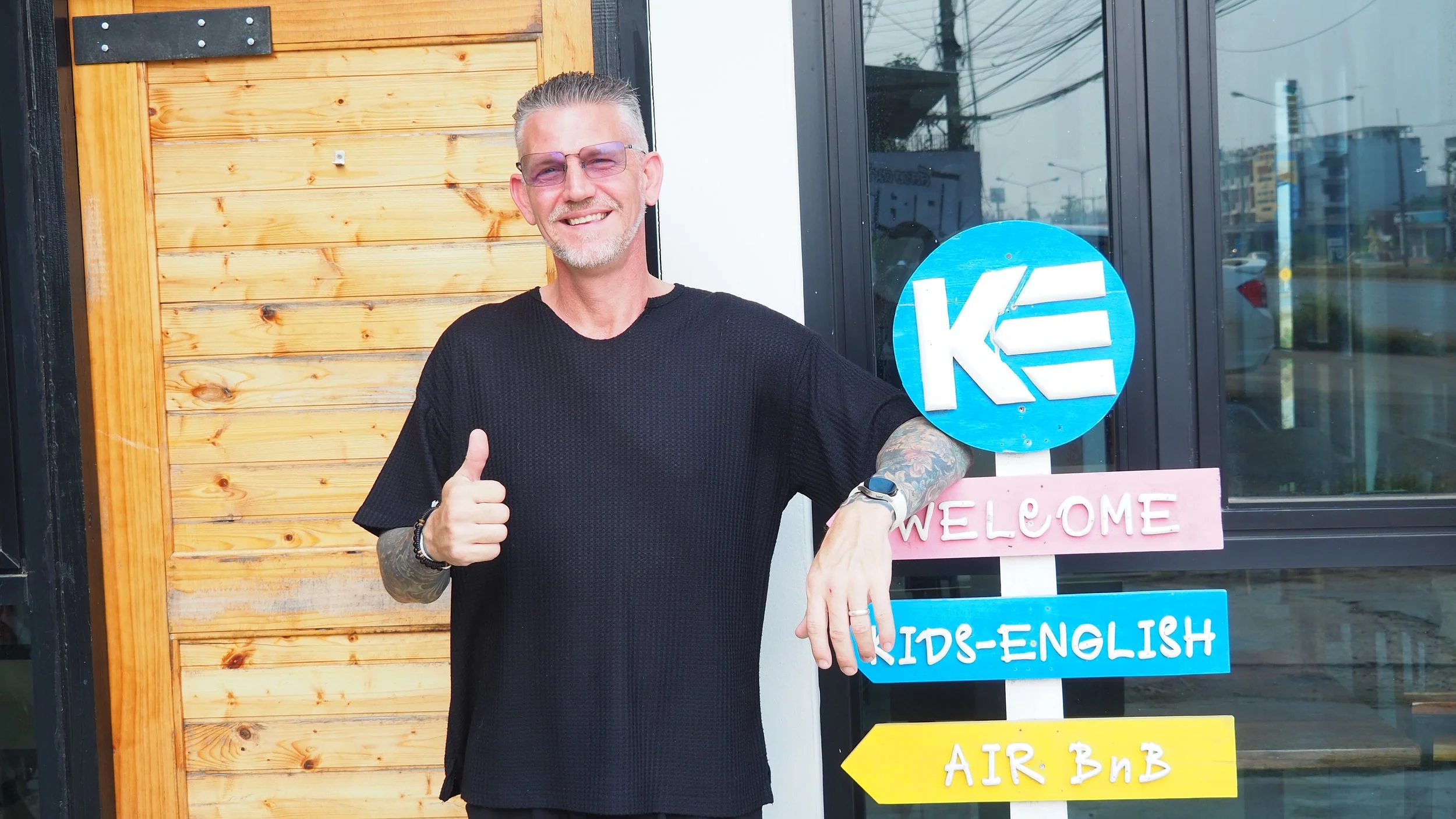
MATTHEW JOHN 20-Year Veteran Operations Manager Family Legacy Rooted in Sukhothai since 1945.

Matthew John

Matthew John | 20-Year Veteran & Operations Manager

Matthew John is the founder of Kids English Thailand (KET) and a distinguished authority in Thai educational management with 20+ years of on-the-ground experience. A recipient of the UKโ€™s Young Achiever of the Year Award (presented at St. James's Palace by King Charles III at the Pride of Britain Awards). Matthew and KET have successfully led over 1,500 teachers through the complexities of Non-B Visas and 2026 Digital Work Permits.

A Legacy Rooted in the Heartland Matthewโ€™s expertise is backed by a deep local heritage in Ban Lum, Sukhothai, dating back to 1945. He has been married for 19 years to Kanjani, a veteran Educator and Assistant Director in the Thai Civil Service with over 20 years of administrative experience. Together, they are raising their two children, Ayden (17) and Ameleah (14), in the community they serve.

This unique family foundation allows Matthew to bridge the gap between global educators and Thailandโ€™s premier academic institutions, providing a "Professional Umbrella" of legal and cultural security that only a local veteran can offer.

Connect with Matthew on LinkedIn

Ask me anything about 2026 Visas

https://www.kidsenglishthailand.org
Previous
Previous

Non-B Visa Run to Laos: The Teacher's Mission Bible (Meesuk)

Next
Next

THAILAND E-WORK PERMIT: PRACTICAL TEACHER GUIDE