
Thai English Camp Playbook (2026): Station Rotations & Games for 200+ Kids
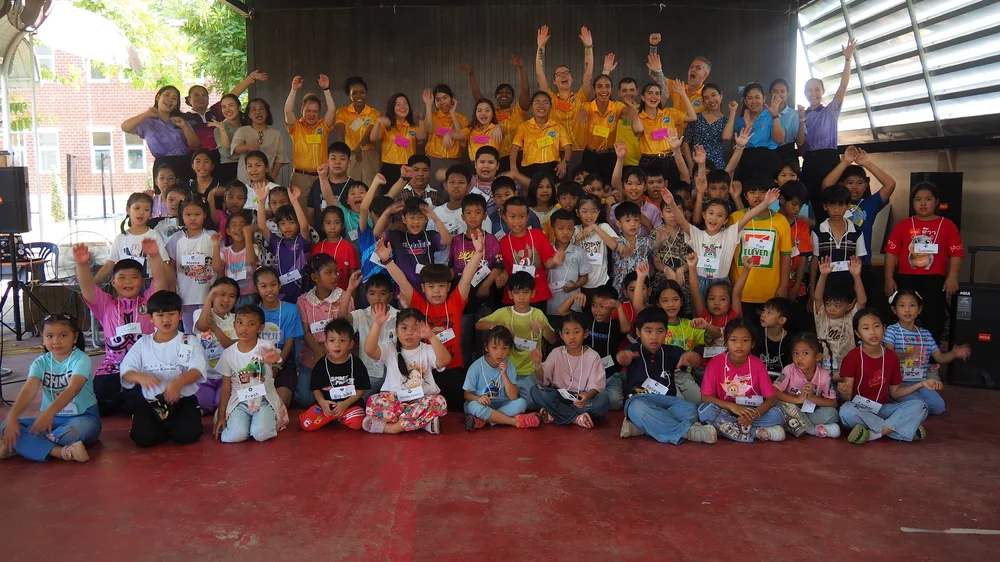
The Thai English Camp Playbook: Station Rotations & Games ⛺🐘
Managing 150 to 250+ Thai students in a single school auditorium is an exhilarating coordination challenge. Discover KET's field-tested station rotation model: engineered to lower Krashen's Affective Filter, navigate Kreng Jai hesitation, and guarantee massive spoken English output!
Why Whole-Group Camps Fail (and Why Rotations Win)
Understanding student psychology, performance anxiety, and the power of small-group cohorts.
The Shy Spectrum 😶
When 200 children sit facing a stage, a handful of confident students answer the microphone while the majority remain passive. Whole-group setups create intense self-consciousness, leading to classroom hesitation and minimal individual speaking output.
Affective Filter Spike 📉
Second language acquisition principles show that stress, embarrassment, and sensory overload raise the Affective Filter, blocking natural language absorption. A noisy, sweltering auditorium amplifies this barrier dramatically.
Rotational Movement ⚡
Dividing the cohort into small mobile teams of about 18 to 25 students creates a responsive, structured rhythm. Moving from one station to another every 25 minutes naturally resets student energy and keeps attention sharp.
One-Day Master Schedule: 200 Students Across 8 Stations
Field-tested timetable for school campuses, balancing high-energy stations with mandatory hydration breaks.
| Time Window | Activity Phase | Operational Details & Team Mechanics |
|---|---|---|
| 08:30 to 09:00 | Opening & Team Division (พิธีเปิดและแบ่งกลุ่ม) | Cohort assembly, team wristband distribution, and whole-hall energetic warm-up cheer led by foreign educators. |
| 09:00 to 09:25 | Station Round 1 (กิจกรรมประจำฐาน รอบที่ ๑) | Teams 1 to 4 engage Stations A to D; Teams 5 to 8 engage Stations E to H. High-output small-group practice. |
| 09:30 to 09:55 | Station Round 2 (กิจกรรมประจำฐาน รอบที่ ๒) | 5-minute music-guided transition. Teams rotate clockwise to their next designated station station. |
| 10:00 to 10:20 | Hydration & Shade Reset 💧 (พักดื่มน้ำและคลายร้อน) | Mandatory cool water and shade break. Staff tally team points while students rest out of direct sun. |
| 10:25 to 10:50 | Station Round 3 (กิจกรรมประจำฐาน รอบที่ ๓) | Third rotation. High-output oral interviews, rhythm games, and past tense mime challenges. |
| 10:55 to 11:20 | Station Round 4 (กิจกรรมประจำฐาน รอบที่ ๔) | Final station rotation. Vocabulary scavenger hunts, command obstacle courses, and category relays. |
| 11:30 to 12:00 | Showcase & Certificates 🏆 (การแสดงและมอบเกียรติบัตร) | Team cheer presentations, teacher shout-outs, official certificate handout, and group photo. |
Four Core Station Plans: 25-Minute Blueprints
Structured 25-minute lesson outlines with foreign lead instructions, Thai co-teacher roles, and target sentence frames.
🎯 Station A: Human Bingo Blitz
Pedagogical Focus: Present Simple question formation (Do you like...?, Can you...?), peer interviewing, and active listening comprehension.
• Question: "Do you like [som tam / football / K-Pop]?" → Answer: "Yes, I do!" / "No, I do not."
• Question: "Can you [ride a bicycle / swim / play guitar]?" → Answer: "Yes, I can!" / "No, I cannot."
25 printed Bingo grids with Thai-relevant prompts, 25 pens, portable Bluetooth speaker for background rhythm, mini whiteboard for visual modeling.
- 1 Demonstrate with Thai Co-Teacher (3 Mins): Foreign teacher models asking: "Do you like som tam?" The Thai co-teacher responds with "Yes, I do!" and signs the matching box on the card.
- 2 Active Peer Mingle (17 Mins): Play upbeat background music. Students mingle and interview peers. Enforce the fairness rule: a single classmate may only sign your sheet twice.
- 3 Bingo Verification (5 Mins): When a student completes a row or column, verify their card by having them share three complete sentences about their peers.
🎭 Station B: Name + Action Memory Chain
Pedagogical Focus: Personal introductions (I am [Name]!), third-person pronouns (He is [Name], She is [Name]), and movement memory.
• Self: "I am [Art]!" + [Claps overhead twice]
• Memory Chain: "He is [Art] (Clap), She is [Joy] (Spin), and I am [Bank]!" + [Waves elephant trunk]
Open floor space, soft beanbag or squishy foam ball for speed rounds.
- 1 Create Parallel Circles (2 Mins): Split the station cohort into two smaller circles of 10 to 12 students. Foreign lead coordinates Circle 1; Thai assistant facilitates Circle 2.
- 2 Build the Movement Chain (18 Mins): Foreign lead starts with an energetic action. Pass clockwise: each child repeats all prior names and movements before adding their own.
- 3 Speed Challenge (5 Mins): Challenge the circle to complete the full sequence in under 30 seconds. If someone stumbles, the whole circle chants together to support them!
🗣️ Station C: WH-Question Interview Carousel
Pedagogical Focus: Rapid questioning with Who, What, Where, When, Why, How and full-sentence personal answers.
• What: "What is your favorite Thai food?" → "My favorite Thai food is pad krapao."
• Where: "Where do you want to travel?" → "I want to visit Chiang Mai."
• Who: "Who is your favorite singer?" → "My favorite singer is Lisa."
Whiteboard with pre-written question prompts, whistle or bell for rotation signaling.
- 1 Form Facing Lines (3 Mins): Arrange students in two parallel lines facing one another 1 meter apart (Line A faces Line B).
- 2 90-Second Conversations (17 Mins): Point to Question 1. Line A asks Line B; Line B answers and asks in return. When the whistle blows, Line A takes one step to the right!
- 3 Partner Spotlight (5 Mins): Point to a fresh question prompt every 2 rotations. Conclude by having 3 students report what their partner shared.
🎬 Station D: Past Tense Mime & Chain Story
Pedagogical Focus: Past simple regular (-ed) and irregular verb conversion (eat → ate, go → went, see → saw).
• Regular: played football ⚽, watched movies 🎬, washed hands 🧼
• Irregular: ate noodles 🍜, went to 7-Eleven 🏪, drank iced milk tea 🧋
• Guessing Frame: "Yesterday you [ate noodles]!" → "Yes, yesterday I [ate noodles]!"
20 laminated action cards with past tense verbs and pictures, score tracking board.
- 1 Quick Verb Drill (4 Mins): Write 8 common verbs on the board in present and past columns. Practice choral pronunciation together.
- 2 Silent Mime Guessing (16 Mins): Student A draws a card and acts out the action silently. Teammates raise their hand to guess using complete past tense sentences.
- 3 Chain Story (5 Mins): Form a circle. Student 1 says "Yesterday I ate mango." Student 2 continues: "Yesterday I ate mango and bought ice cream."
Co-Teacher 3-Minute Pre-Briefing Protocol (การประสานงานครูพี่เลี้ยง)
Before Station Round 1 begins, gather all Thai co-teachers and student assistants for a quick briefing. Hand out station cards and instruct assistants: "Avoid translating English sentence prompts directly into Thai. Instead, model the answer once and point to the written board prompt!" This simple adjustment encourages students to process English directly.
Cultural Dynamics in Thai Camps: The Triad
How understanding Sanuk, Kreng Jai, and Jai Yen makes your camp run smoothly.
Playful Enthusiasm
In Thailand, learning must feel engaging and joyful. If a station feels like a dry test, students naturally lose interest. Keep energy high with songs, friendly team points, and upbeat demonstrations.
Managing Hesitation
Thai children hesitate to speak if they worry about making a public mistake or imposing on others. Frame every speaking prompt as a cooperative team game so no single child feels exposed.
Calm Leadership
Schedule changes, room adjustments, or audio hiccups are normal in school life. Keep a cool heart and a welcoming smile. Thai staff and students respond warmly to steady, patient leadership.
📣 Ready Call-and-Response Camp Cheers & Signals
Use when setting up stations or getting crowd attention:
Students: "We are ready! (Clap-Clap-Clap)"
Teacher: "A-One, A-Two?"
Students: "A-One-Two-Three!"
The classic Thai school rhythm reset:
Teacher: "Clap 2! (Clap-Clap)"
Teacher: "Clap 5! (Clap-Clap-Clap-Clap-Clap)"
Students: "Hoo-Ray!" (Hands up!)
Clean audio commands to prevent shouting:
2 Short Blasts: Rotate clockwise to next station.
3 Short Blasts: Return to central team circle.
What Looks Good on Paper (but Fails in the Field)
Common pitfalls to avoid when coordinating large-scale school camps in Thailand.
❌ Long Stage Explanations
Talking through rules on a microphone for more than 5 minutes causes attention to wander quickly. Always explain station rules by demonstrating them physically in 60 seconds.
❌ Overly Complex Crafts
Spending 40 minutes cutting paper or coloring drawings produces almost zero spoken English. Save camp time for active verbal games, movement challenges, and communication drills.
❌ Public Ranking of Shy Kids
Never single out lower-level students or force shy children to perform alone on stage. Always award points to teams as a group to protect student dignity and confidence.
❌ Ignoring the Afternoon Heat
Running physical relays outdoors under direct midday sun leads to rapid fatigue. Always provide plenty of drinking water, schedule energetic relays before 10:30 AM, and keep afternoon activities in shaded halls.
Interactive Camp Checklist & Closing Ceremony
Organized steps from morning setup to certificate presentation, backed with interactive browser storage.
Camp Readiness & Supply Checklist
Track equipment, team wristbands, audio gear, and certificates before student arrival.🏆 The 30-Minute Closing Showcase Framework
- Team Cheers (5 Mins): Each team presents their 10-second group cheer created during morning warm-ups.
- Student Spotlight (10 Mins): Invite student volunteers to showcase vocabulary or sentences practiced at stations.
- Certificates & Photo (15 Mins): Present team awards, thank Thai co-teachers, and take an energetic group photo with school directorship.
English Camp Operations FAQ
Why do traditional whole-group English camps fail with large Thai student cohorts?
How many students should be in each station rotation team?
What staffing ratio is recommended per rotation station?
How do Thai cultural concepts like Sanuk, Kreng Jai, and Jai Yen impact camp success?
What should the whistle and music rotation signal be?
Written by Matthew John
Co-Founder & Operations Manager : 20 Years in ThailandMatthew John is the co-founder of Kids English Thailand (KET) and an authority in Thai educational recruitment with 20 years of on-the-ground experience. Matthew and KET have placed over 1,500 teachers through Non-B Visas, Digital Work Permits, and school English camps across Northern Thailand since 2009.
